Standard vs Custom Press Brake Tooling: A Comparison Guide for Bending Projects
If a part is air-bent on mild steel at a common angle, with an inside radius that sits inside a catalogue range, standard press brake tooling is normally the faster and cheaper answer. The moment a project fixes its own inside radius, falls outside the thickness range a standard V-die opening supports, or uses stainless steel instead of mild steel, the catalogue stops matching the part and custom tooling becomes the working option rather than an upgrade.
That short answer hides the real difficulty. Standard and custom tooling are not two quality tiers of the same product. They are two fit categories, and the correct choice depends on the bending project itself, not on the buyer's budget or the supplier's product list.
This guide compares both routes against four project scenarios that buyers actually bring to a tooling supplier: single-piece tooling, batch standard tooling supply and replacement, full-line tooling configuration, and automated high-repeatability lines. It also shows how four variables — bend angle, R-value, material thickness and stainless steel behaviour — move the decision, and how ZNW's standard and custom ranges, interchangeability and multi-brand compatibility with AMADA, WILA/TRUMPF, LVD and BYSTRONIC fit into it.
Problem Definition: The Decision Buyers Actually Face
Choosing between standard and custom tooling looks like a catalogue question. In practice it is a project question, because four variables change the answer: inside bend radius (R), material thickness, bend angle, and material grade. A fifth variable, production cadence, decides how much repeatability the tool has to hold over the life of the job.
Two failure modes appear repeatedly in bending projects. The first is specifying custom tooling when a standard punch and die set would have formed the part — this adds engineering time and extends the delivery schedule for no forming benefit. The second is forcing standard tooling onto a part it was never designed to form, which risks angle deviation, surface marking, overloading of the punch tip, and unplanned machine downtime while a replacement is sourced.
The practical rule: standard tooling covers air-bent parts whose geometry sits inside a published catalogue range. Custom tooling covers the parts that sit outside it — different R-value, unusual bend angle, material thickness beyond the die opening, stainless or high-yield grades, and special forming profiles such as hemming or radius dies.
Before comparing prices or lead times, a buyer should be able to answer five questions about the job:
- Geometry: what inside radius and bend angle does the drawing actually specify?
- Material: mild steel, stainless steel, or a high-yield grade, and at what thickness?
- Machine interface: which press brake system and holder or clamping style will carry the tool?
- Cadence: one-off bending, batch production, or an automated line running repeatable cycles?
- Replacement plan: who supplies the next set when the current tooling wears?
Industry Background: Why the Standard/Custom Split Keeps Growing
Tooling demand follows machine demand, and the installed base of CNC press brakes keeps expanding. A secondary industry report published in 2026 (HD Machinery) estimates that CNC press brake penetration will rise from 35.8% in 2024 to 52.8% in 2026. A separate market report on press brakes estimates the global press brake machine market at USD 5.2 billion in 2024, projected to reach USD 7.6 billion by 2030.
The scale of the equipment manufacturers that shape tooling interfaces is equally relevant. Amada Group's Sheet Metal Division recorded sales of JPY 296,853 million for the fiscal year ended March 2025, according to Amada's own segment reporting. WILA Tooling relocated its North American headquarters to Louisville, Kentucky in May 2023 and established local manufacturing for New Standard tooling, according to the company's own announcement.
Three practical consequences follow for buyers:
- More CNC machines in service means tighter expectations for bending accuracy, which pushes tooling specification from a generic purchase to an engineering decision.
- Many fabrication shops run mixed machine fleets, so tooling that is interchangeable across AMADA, WILA/TRUMPF, LVD and BYSTRONIC systems reduces the number of spare sets a shop must hold.
- Cross-border procurement is routine: press brake tooling is generally classified under HS Code 820730 for interchangeable tools for pressing, stamping or punching, which importers use when calculating landed cost.
Against that background, the standard-versus-custom question is no longer asked once at the start of a project. It is asked again at every replacement cycle and every time a new part enters the production schedule.
Detailed Solution: How ZNW Structures Standard and Custom Tooling
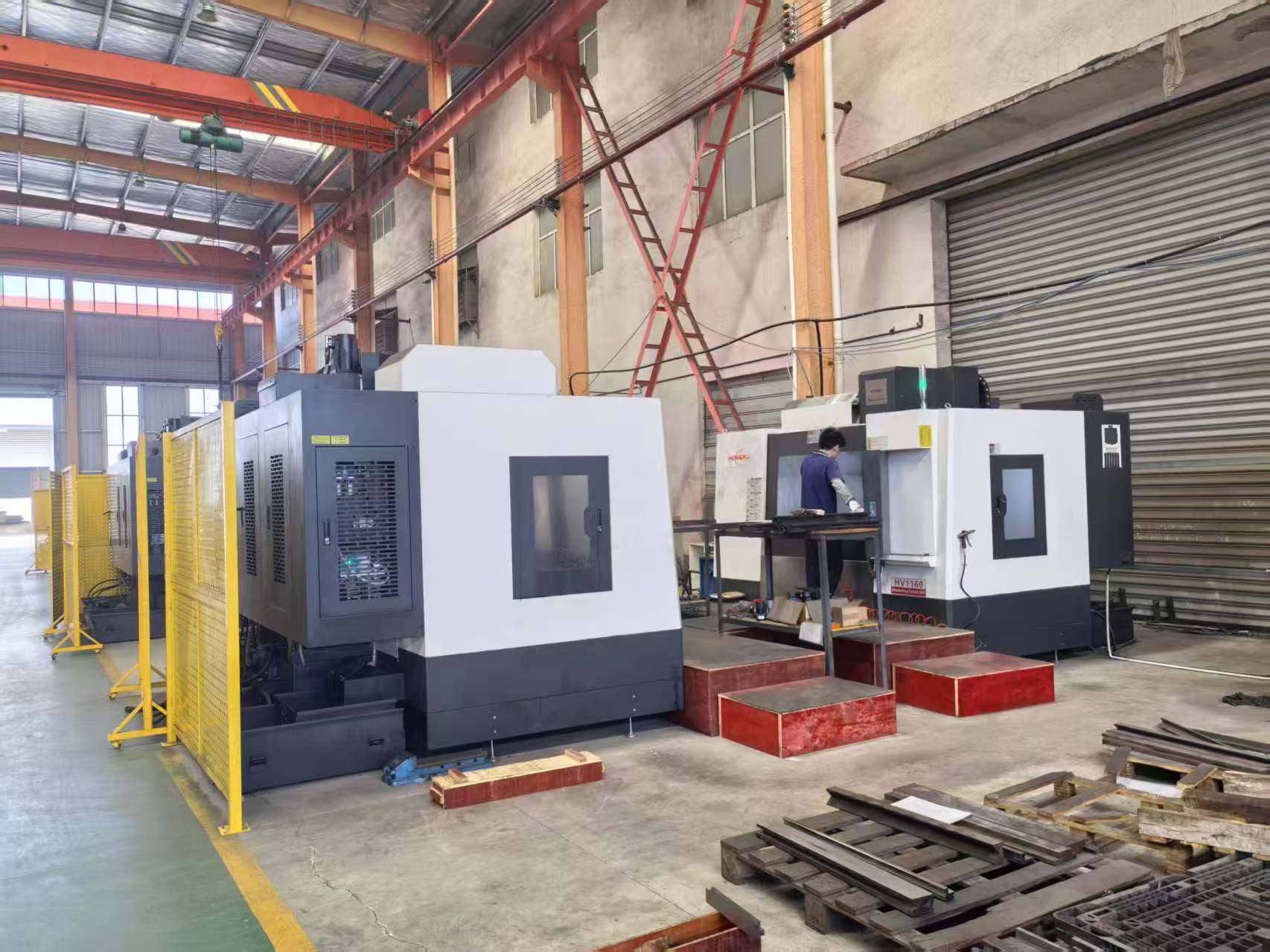
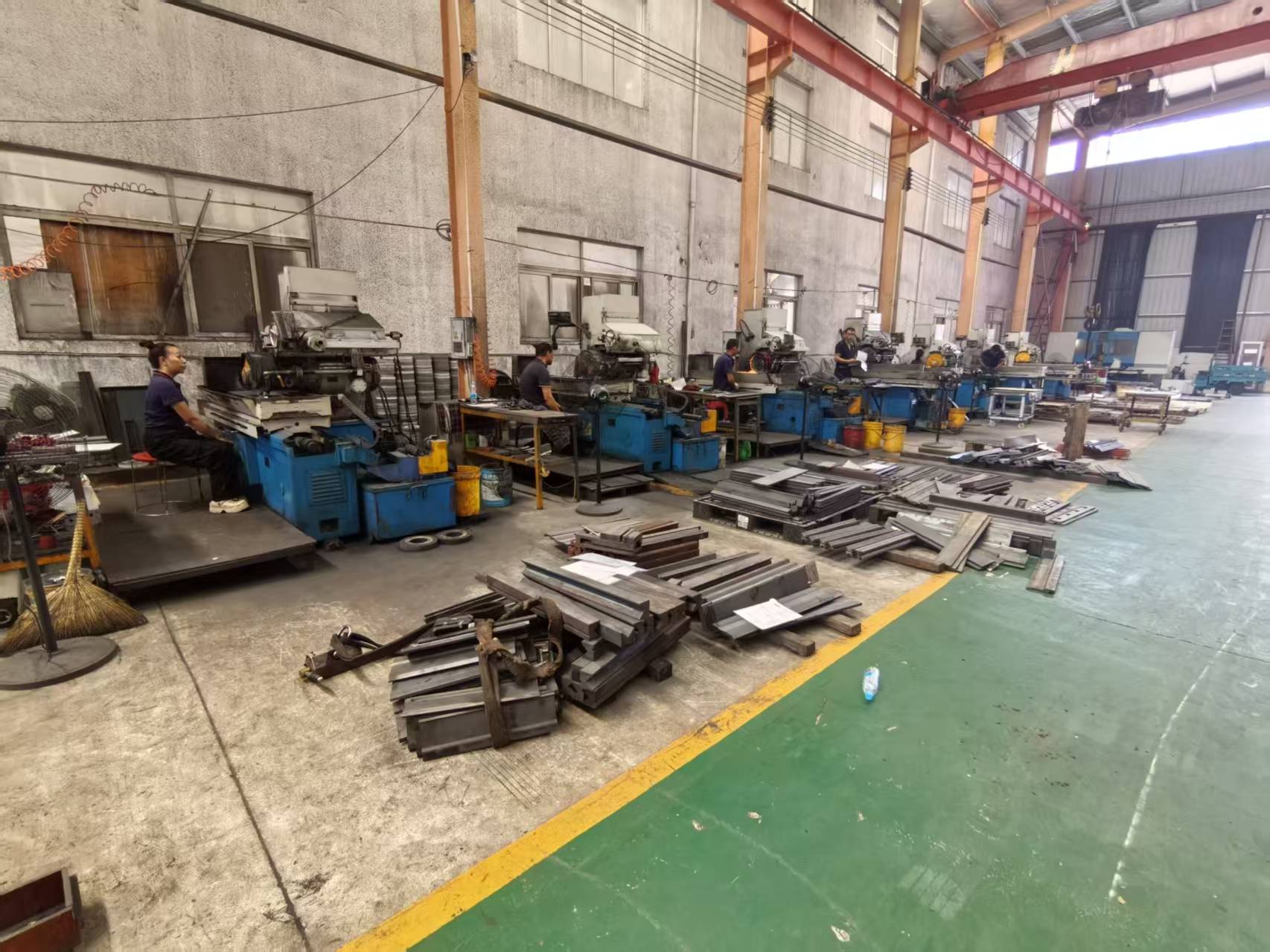
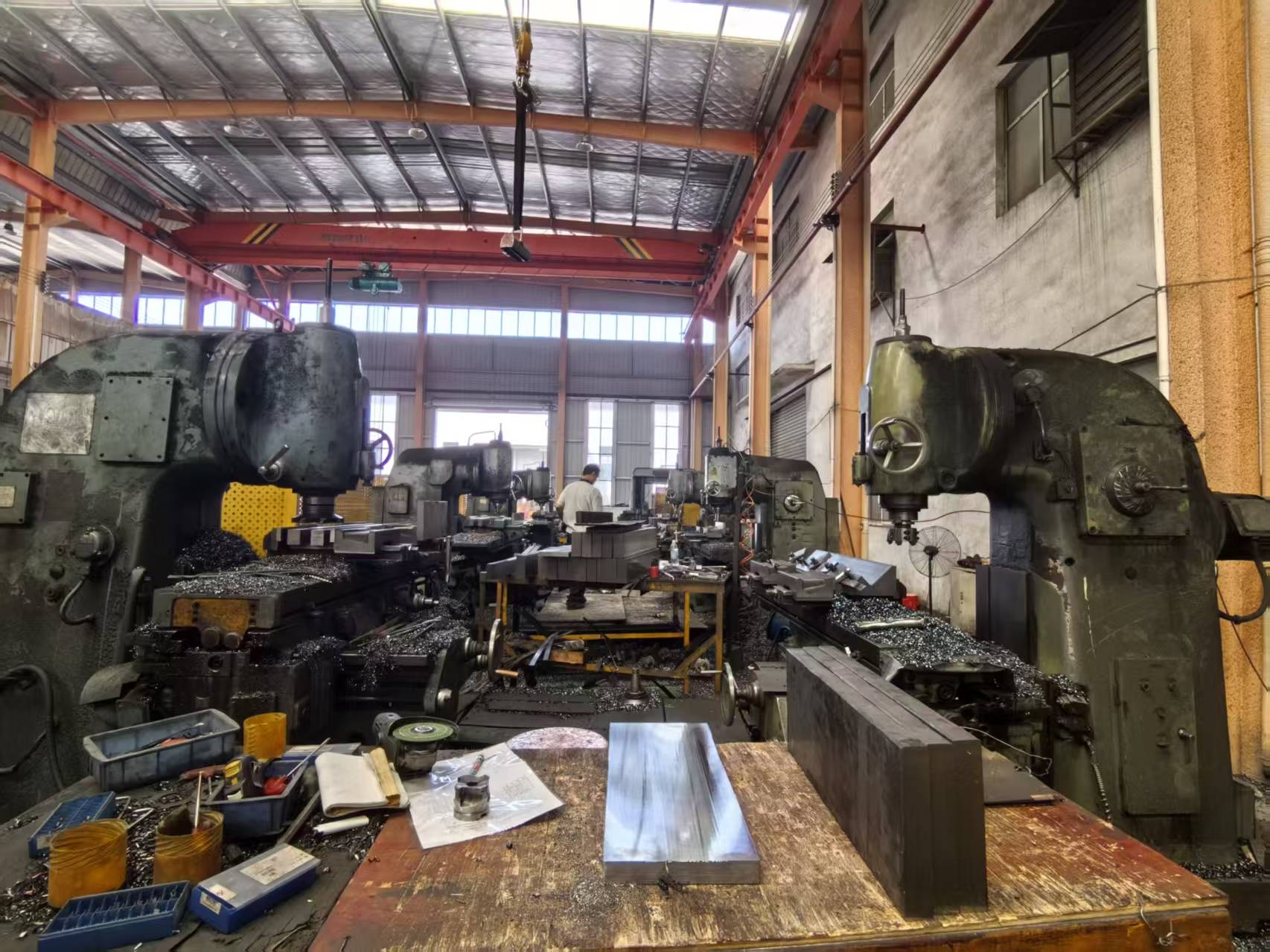
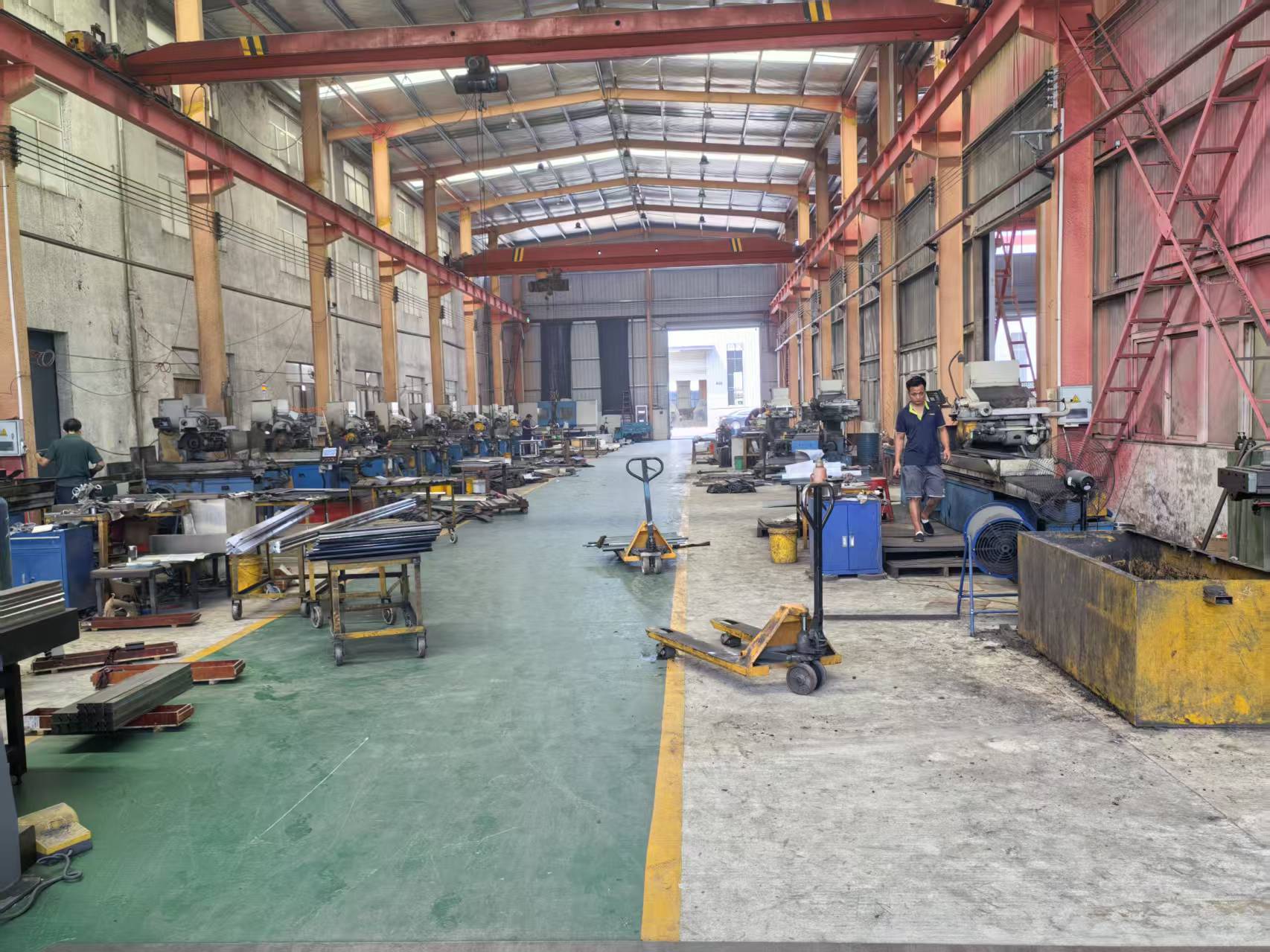
ZNW Press Brake Tooling is the tooling brand of Ma'anshan Zhuonaiwei Machinery Equipment Co., Ltd, a manufacturer based in Ma'anshan, Anhui, that produces high-precision press brake punches, dies and customised die solutions for sheet metal forming. The company operates a 5,000 m² factory with around 150 employees, including roughly 20 engineers in its R&D team, and reports an export ratio of about 80%. Monthly production capacity for press brake tooling ranges from 10,000 to 30,000 units, with annual output of 120,000 to 300,000 units.
The standard range: what is available off the catalogue
ZNW's standard range covers standard press brake punches and dies, European and American-style dies, die solutions compatible with WILA and Trumpf, flanging dies and special bending dies, adjustable bottom tools, formed moulds, hemming dies, radius dies, and Rolla-V and other special tooling. In a project context, the standard range is the correct route when the part is air-bent at a common angle, the specified inside radius falls inside the catalogue range, the material is mild steel within the thickness the die opening supports, and the machine interface is a mainstream system.
The custom range: OEM and ODM profiles
ZNW provides OEM production services for press brake tooling, including custom punch and die profiles. It also offers ODM services that include tooling design and development, which means the supplier can take a drawing or a part sample and engineer the forming tool rather than only reproducing a catalogue item.
Customisation is supported according to bend angle, R-value, system compatibility with AMADA, WILA, LVD and BYSTRONIC, and special forming requirements. Tools can also be customised for material thickness and production cadence. Stainless steel and high-yield materials require special tooling selection and heat-treatment recommendations, because these grades typically spring back more and demand more of the punch tip than mild steel does.
Material and hardness: the numbers behind tool life
ZNW's standard tool material is 42CrMo alloy steel. A third-party material guide published by AccurTool describes 42CrMo (AISI 4140) as the industry-standard material for precision press brake tooling, generally offering a surface hardness of HRC 47 ± 2 after heat treatment. ZNW states that its standard heat treatment for the mould yields a hardness of 45–50 HRC, while laser hardening can achieve up to 60 HRC.
For a buyer, the difference is a project decision rather than a quality grade. Standard heat treatment covers the majority of air-bending work; the higher laser-hardened figure is stated by the manufacturer as an option on the same tooling family. Higher hardness is generally associated with better wear resistance, which matters most where tooling runs long cycles or forms harder material.
Interchangeability and multi-brand compatibility
Press brake tooling operates as removable upper and lower tool components on CNC press brakes and is designed to support quick changeovers between operations. Compatibility is confirmed against the machine rather than against the brand name alone: customisation is supported for AMADA, WILA, LVD and BYSTRONIC systems, and ZNW asks buyers to send the machine model so the punch and die profiles are matched to the actual holder and clamping arrangement.
The matched equipment list includes press brake machines, holders and tool clamps, positioning aids, protective films and tool storage systems. For a shop running a mixed fleet, that combination is what makes a single spare-parts strategy possible: one tooling family, several machine interfaces, fewer sets held in the rack.
Compliance and quality control
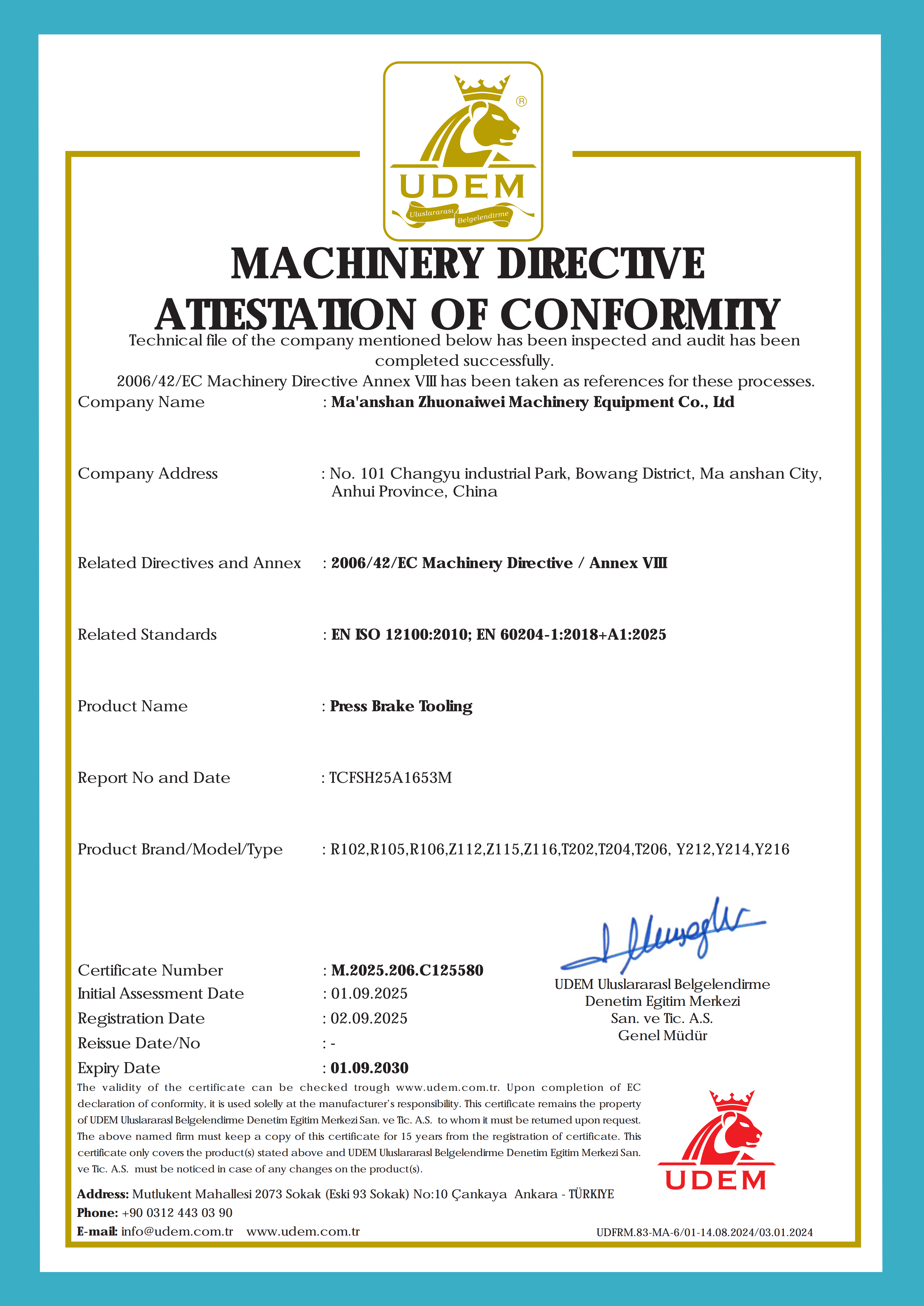
ZNW's press brake tooling holds CE certification number M.2025.206.C125580, issued by UDEM Uluslararasi Belgelendirme for the EU/EEA market on 2 September 2025 and valid until 1 September 2030. The certificate scope covers press brake tooling model codes R102, R105, R106, Z112, Z115, Z116, T202, T204, T206, Y212, Y214 and Y216, and the assessment references EN ISO 12100:2010 and EN 60204-1:2018+A1:2025.
Because the CE scope is model-specific, buyers importing into the EU/EEA should confirm that the exact item ordered falls inside the listed model range. This is a documentation check, not a technical obstacle, and it is one of the reasons a machine-model-based quotation is more reliable than a generic catalogue order.
Quality control is stated as a fixed sequence: visual inspection, critical dimension checks, geometric tolerance checks, assembly and fit verification, hardness testing, and a final release check. The assembly and fit check matters for custom tooling in particular, because a custom punch that measures correctly but does not seat in the holder will still stop the job.
Step-by-Step Breakdown: Choosing Between Standard and Custom Tooling
Step 1 — Define the bend, not the tool
Start with the part: material grade, thickness, target inside radius, bend angle on the drawing, and flange length. These four or five values determine almost everything that follows. R-value and material thickness are the two variables that most often eliminate the standard route on their own.
Step 2 — Confirm the machine interface
Identify the press brake system and the holder or clamping style. Because ZNW supports system compatibility across AMADA, WILA, LVD and BYSTRONIC, this step is about exactness rather than availability: send the machine model so the profile is matched to the real interface.
Step 3 — Test the drawing against the standard range
If the part is air-bent at a common angle on mild steel, with an R-value inside the catalogue range and a thickness the die opening supports, take the standard route. Standard dies, adjustable bottom tools and European or American-style punches cover a large share of everyday fabrication work, and standard tooling also keeps replacement simple.
Step 4 — Escalate to custom when a trigger is hit
Move to custom tooling when the drawing demands a specific R-value outside the standard range, a bend angle the catalogue does not carry, a thickness beyond the die opening, stainless or high-yield material, or special forming such as hemming, flanging or radius forming. Those are exactly the conditions ZNW lists as customisation inputs — bend angle, R-value, system compatibility and special forming requirements, with tooling design and development included in ODM work.
Step 5 — Validate with fit and hardness data
Ask for the inspection record. The relevant checks are critical dimensions, geometric tolerances, assembly and fit verification, and hardness testing. On custom single-piece tooling, the fit check against the holder is the step that prevents a correctly dimensioned tool from becoming a commissioning problem.
Step 6 — Plan supply and replacement
Standard tooling has a typical production lead time of 15 to 25 days, with shipment in 3 days, and a minimum order quantity of 1 piece with multiple-order discounts available. Monthly capacity of 10,000 to 30,000 units gives headroom for batch supply and replacement programmes. Custom tooling, by contrast, includes design and development before production, so its schedule is set per project and confirmed with the quotation.
Use Cases: Four Bending Project Scenarios
Scenario 1 — Single-piece tooling for a difficult part
A fabricator receives one enclosure or bracket that requires an inside radius no standard punch can produce. There is no volume to justify a stock position, and the part still has to be delivered. This is the clearest custom case: a single-piece tool built to the R-value, bend angle and material thickness on the drawing, produced through OEM or ODM custom punch and die profiles. The decision rule is simple — if no catalogue item produces the specified radius, custom is not a preference, it is the only route.
Scenario 2 — Batch standard tooling supply and replacement
A shop running repeat work on mild steel wears out punches and V-dies on a predictable cycle. Here standard tooling is the right answer, and the project is a supply and replacement programme rather than a forming problem. Minimum order quantity of 1 piece with multiple-order discounts, monthly capacity of 10,000 to 30,000 units, and a 15 to 25 day lead time with 3-day shipment all support planned replenishment, which is materially cheaper than emergency buying after a tool fails mid-job.
Scenario 3 — Full-line tooling configuration
A new production line needs a complete set: standard punches for routine bends, adjustable bottom tools for flexibility, hemming and radius dies for finishing operations, and possibly a custom profile for one signature part. Because ZNW's range spans standard dies, adjustable bottom tools, formed moulds, hemming dies, radius dies and Rolla-V special tooling, the line can be configured from a mixed standard-plus-custom set instead of treating every position as a custom project. The engineering review available before quotation is where that mix is decided.
Scenario 4 — Automated high-repeatability lines
Automated bending cells are the most demanding case for tooling selection. ZNW states that its tooling suits regular and medium-to-high tonnage air bending as well as automated, high-repeatability bending production lines. In this scenario the tooling has to hold angle consistency across thousands of cycles, which raises the weight of hardness specification, fit accuracy and quick-changeover capability. Customisation for production cadence is explicitly supported, and this is where the 45–50 HRC standard heat treatment and the up-to-60 HRC laser-hardened option become a documented choice rather than an assumption.
A related pattern appears in ZNW's case summaries, which describe a three-year, 50-unit supply relationship with industrial manufacturers and sheet metal fabricators covering custom tools, worn tooling replacement and formed solutions for complex bends, with reported improvements in bending accuracy and production efficiency. That mix — some custom, some replacement — is typical of how the standard-versus-custom question resolves in real shops.
Standard vs Custom Press Brake Tooling: Comparison Table
| Decision factor | Standard press brake tooling | Custom press brake tooling |
|---|---|---|
| Best fit | Air bending at common angles on mild steel, geometry inside the catalogue range | Drawings outside the catalogue: specific R-values, unusual bend angles, special forming |
| Geometry and R-value | Fixed by the catalogue item selected | Customised by bend angle and R-value |
| Material and thickness | Standard 42CrMo with 45–50 HRC heat treatment | Customised for material thickness and cadence; stainless and high-yield grades require special selection and heat-treatment recommendations |
| Machine compatibility | European and American-style dies; die solutions compatible with WILA and Trumpf | System compatibility with AMADA, WILA, LVD and BYSTRONIC, confirmed by machine model |
| Engineering input | Selection and fit confirmation only | OEM custom punch and die profiles; ODM tooling design and development |
| Order quantity | Minimum order quantity 1 piece, multiple-order discounts available | Confirmed per project after the engineering review |
| Lead time | 15–25 days for standard tooling, shipment in 3 days | Scheduled per project, after design and development |
| Typical use | Batch standard tooling supply and replacement | Single-piece tooling, full-line configuration, automated high-repeatability lines |
The same logic can be reduced to a routing table for day-to-day decisions:
| Project situation | Recommended route | Why |
|---|---|---|
| One part, radius outside the catalogue | Custom single-piece tooling | No standard item produces the specified R-value |
| Repeat mild-steel work, predictable wear | Standard tooling programme | MOQ 1 piece, multiple-order discounts, 15–25 day lead time |
| New line with mixed operations | Standard plus custom mix | Adjustable bottom tools, hemming, radius and Rolla-V special tooling alongside one custom profile |
| Automated cell, high cycle count | Custom tooling with defined hardness | Cadence-based customisation plus 45–50 HRC standard or up-to-60 HRC laser-hardened options |
Frequently Asked Questions
Will ZNW press brake tooling fit my AMADA, WILA/TRUMPF, LVD or BYSTRONIC press brake?
ZNW supports customisation by system compatibility with AMADA, WILA, LVD and BYSTRONIC press brake systems, and its standard range includes European and American-style dies plus die solutions compatible with WILA and Trumpf. Fit is confirmed against the actual machine: ZNW asks buyers to provide the machine model so the punch and die profiles are matched to the real holder and clamping arrangement rather than to a brand name alone.
Can ZNW manufacture custom press brake punches and dies for a specific bend angle, R-value and material thickness?
Yes. ZNW provides OEM production services for press brake tooling, including custom punch and die profiles, and offers ODM services that include tooling design and development. Customisation is supported according to bend angle, R-value, system compatibility with AMADA, WILA, LVD and BYSTRONIC, and special forming requirements, and tools can also be adapted for material thickness and production cadence.
What material and hardness does ZNW press brake tooling use, and can it handle stainless steel?
The standard tool material is 42CrMo alloy steel. ZNW states that standard heat treatment yields a hardness of 45–50 HRC, while laser hardening can achieve up to 60 HRC. For reference, a third-party material guide describes 42CrMo (AISI 4140) as the industry-standard material for precision press brake tooling, with surface hardness of HRC 47 ± 2 after heat treatment. Stainless steel and high-yield materials require special tooling selection and heat-treatment recommendations, so these grades should be specified in the enquiry rather than assumed.
What is the minimum order quantity and how are payment terms structured?
The minimum order quantity is 1 piece, with multiple-order discounts available for batch supply. ZNW's published payment structure is staged by order value: full payment on smaller orders, a 50% deposit with the remaining balance settled for shipment on mid-size orders, and a 30% advance payment for large orders. Exact payment and delivery terms are confirmed in the order or technical agreement, along with the final release and trial-fit acceptance criteria.
What is the lead time for standard versus custom press brake tooling?
Typical production lead time for standard tooling is 15 to 25 days, with shipment in 3 days, and monthly capacity runs from 10,000 to 30,000 units. Custom single-piece and full-line tooling require design and development before production, so those schedules are set per project and confirmed with the quotation. To start, send your machine model and part drawings to ZNW for an engineering review — the team reviews compatibility, R-value and material requirements before quoting, and a free catalogue download is available below.
Conclusion: Match the Tooling to the Project, Not the Other Way Around
Standard and custom press brake tooling solve different problems. Standard tooling wins on speed, availability and replacement simplicity: a minimum order quantity of 1 piece, multiple-order discounts, a 15 to 25 day lead time with 3-day shipment, and a range that already covers standard punches and dies, European and American-style dies, adjustable bottom tools, hemming dies, radius dies and Rolla-V special tooling. Custom tooling wins on fit: specific R-values, unusual bend angles, thickness beyond the catalogue, stainless and high-yield grades, and the cadence demands of automated lines.
The four project scenarios in this guide point to one conclusion. Single-piece jobs with a unique radius need custom tooling. Batch standard supply and replacement programmes should stay standard. Full-line configurations are usually a deliberate mix. Automated high-repeatability lines need both — a custom profile where the geometry demands it, and a documented hardness specification such as 45–50 HRC standard heat treatment or up to 60 HRC laser hardening where wear resistance matters.
Compatibility is the thread that runs through all four. Because ZNW supports system compatibility with AMADA, WILA, LVD and BYSTRONIC, and because the tooling operates as removable upper and lower components on CNC press brakes with quick changeovers, a mixed machine fleet does not have to mean a mixed spare-parts inventory. CE certification M.2025.206.C125580, issued by UDEM for the EU/EEA market and valid until 1 September 2030, provides the compliance reference for imports, and the QC sequence of visual inspection, dimension and tolerance checks, assembly and fit verification, hardness testing and final release applies to standard and custom orders alike.
Send your machine model and part drawing
Tell ZNW your press brake system, material, thickness, bend angle and required R-value, and the team will confirm whether standard tooling covers the job or a custom punch and die profile is required. Engineering review before quotation, one-stop procurement, and 42CrMo tooling with 45–50 HRC standard or up to 60 HRC laser-hardened options.
Email: bieber@njzoenova.com | WhatsApp: +8615250990446 | Website: www.znwtooling.com
Have Questions or Need More Details?
Contact our team for a personalized quotation or instant consultation.
Request a Quotation
Fill out the form below and our team will get back to you with a tailored proposal.
WhatsApp Direct Chat
Prefer to chat in real-time? Message us on WhatsApp for instant assistance & quick answers.
- Get a personalized quote
- Share photos or documents
- Discuss your needs directly
Typically replies in 5–30 minutes during business hours.