Press Brake Tooling Partnership FAQ: Fitment, Acceptance Criteria, and After-Sales Support
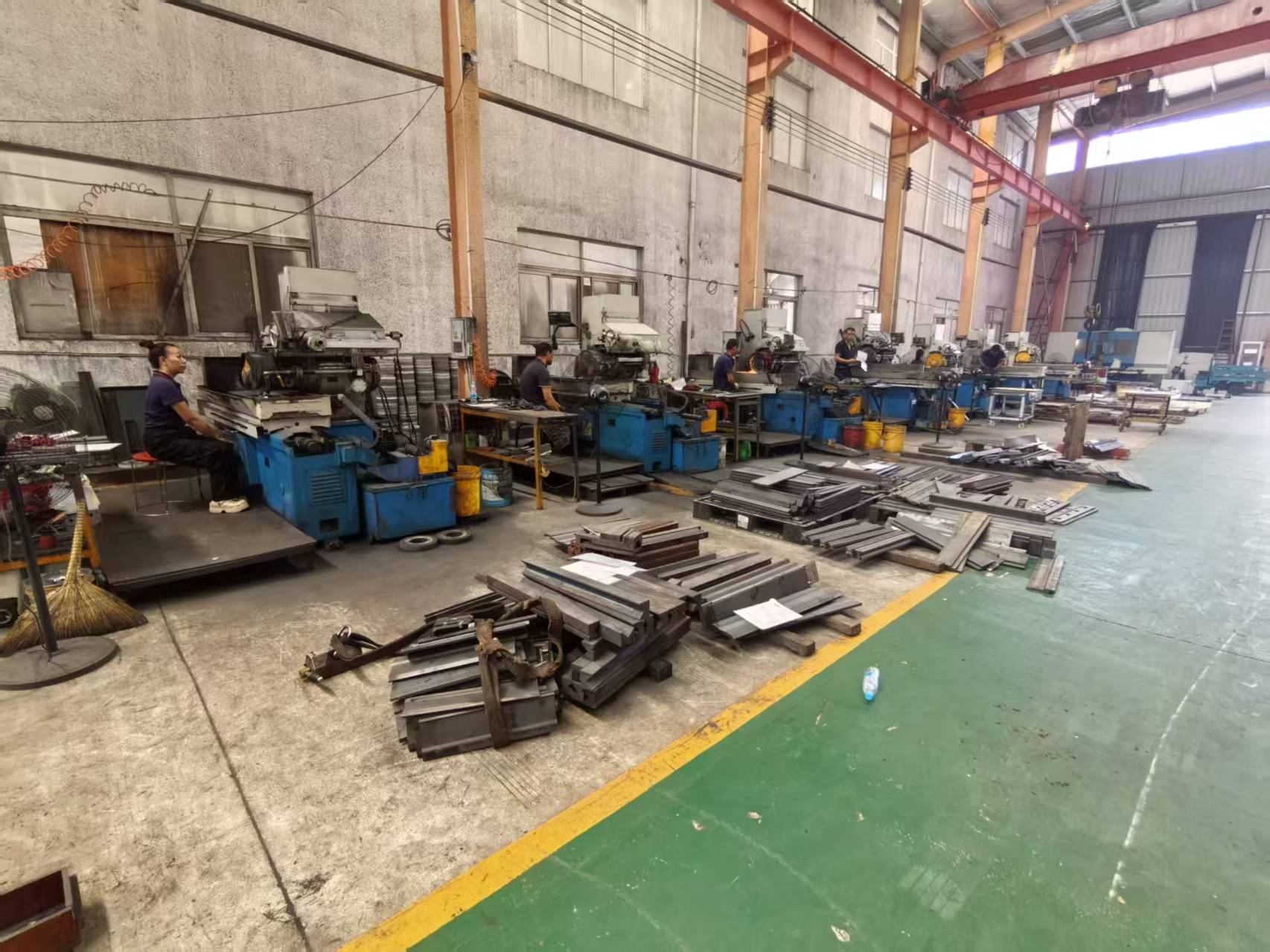
Machining equipment used in press brake tooling production at ZNW Press Brake Tooling, Ma’anshan, Anhui.
A long-term press brake tooling partnership is decided by three questions that can be checked rather than assumed: does the tooling interface with the specific machine and tool holder, is there a written and measurable acceptance standard before the first shipment, and is a named support channel still reachable months after delivery? ZNW Press Brake Tooling — a manufacturer of press brake punches, dies and custom bending tools based in Ma’anshan, Anhui, China — answers all three with product, purchasing and contact facts. This FAQ-style guide walks a buying team through each one in the order a real decision gets made.
Why Tooling Partnerships Fail on Fitment, Acceptance and Support
Most press brake tooling disputes do not begin with service life. They begin with an order that was never pinned down. Three failure points account for the majority of them.
- Fitment was assumed, not specified. A purchase order says “for an AMADA machine” and nothing else. The clamping system, the holder style, and the machine generation are left to interpretation. When the tooling arrives and does not seat correctly, the argument is about what the order meant, not about whether the tool is good.
- Acceptance criteria were never written down. Nobody agreed on forming tolerance, first-article inspection, or what a rejected batch actually looks like. Both sides discover their standards at goods-in, and the gap between them becomes a commercial problem rather than a technical one.
- After-sales support was mentioned at quotation stage and then forgotten. Nobody wrote down who answers, through which channel, or what information the supplier needs to diagnose a problem quickly.
Each of these three can be closed before the first shipment leaves. The rest of this guide shows how, using facts ZNW publishes about its products, processes and contacts.
Industry Background: Why Fitment and Acceptance Matter More Than They Used To
Bending has become more CNC-driven, and that shifts risk toward the tooling interface. Industry data indicates that CNC press brake penetration was expected to rise from 35.8% in 2024 to 52.8% in 2026, according to HD Machinery’s 2026 press brake industry review. The wider machine market is also expanding: the global press brake machine market is estimated at USD 5.2 billion in 2024 and projected to reach USD 7.6 billion by 2030 (Vertex AI Search / Industry Insight).
Two structural facts follow from this for anyone buying tooling.
First, the material baseline is not a matter of preference. 42CrMo alloy steel (AISI 4140) is the industry standard material for precision press brake tooling, offering surface hardness of HRC 47 ± 2 after heat treatment, according to AccurTool’s tooling material guide. Buyers comparing suppliers can therefore anchor the material conversation on a known benchmark instead of on adjectives.
Second, tooling is a traded good, not a captive part. Press brake tooling is generally classified under HS Code 820730 for interchangeable tools for pressing, stamping or punching, which means replacement tooling crosses borders routinely. A shop in Europe or North America evaluating a tooling partner is comparing options from several continents, and the comparison only works if fitment and acceptance are documented rather than implied.
Note that market size figures vary depending on whether a report counts machines only or machines plus tooling. The USD 5.2 billion to USD 7.6 billion range refers to the machine market, not to tooling alone.
What ZNW Press Brake Tooling Actually Supplies
ZNW Press Brake Tooling is a specialized manufacturer focused on high-precision press brake punches, dies and customized die solutions for sheet metal forming. The company is located in Ma’anshan, Anhui, China, and has been in the press brake business for over 20 years.
The operating scale is concrete enough to be checked: a 5,000 m² factory, 150 employees, a 20-engineer R&D team, annual output of 120,000–300,000 units, roughly 80% of production exported, and global market coverage.
The product range covers the buying situations most fabricators actually face:
- Standard press brake punches and dies
- European and American-style dies
- Die solutions compatible with WILA and TRUMPF
- Flanging dies and special bending dies
- Custom press brake dies for complex applications
Material and Manufacturing Process
ZNW tooling is manufactured using 42CrMo alloy steel, CNC machining and heat treatment. The stated purpose of the heat treatment and precision machining steps is to improve tool life and forming accuracy, not merely to raise hardness numbers on a datasheet.
For a buyer, the practical implication is that material specification and process are the two variables to interrogate first. 42CrMo with heat treatment gives a known hardness baseline of HRC 47 ± 2 across the industry; what differentiates suppliers is process control around that baseline — machining consistency, heat treatment discipline, and inspection. ZNW positions its differences from OEM tooling precisely there, and also notes that the size of any gap depends on material specifications, processes and after-sales agreements.
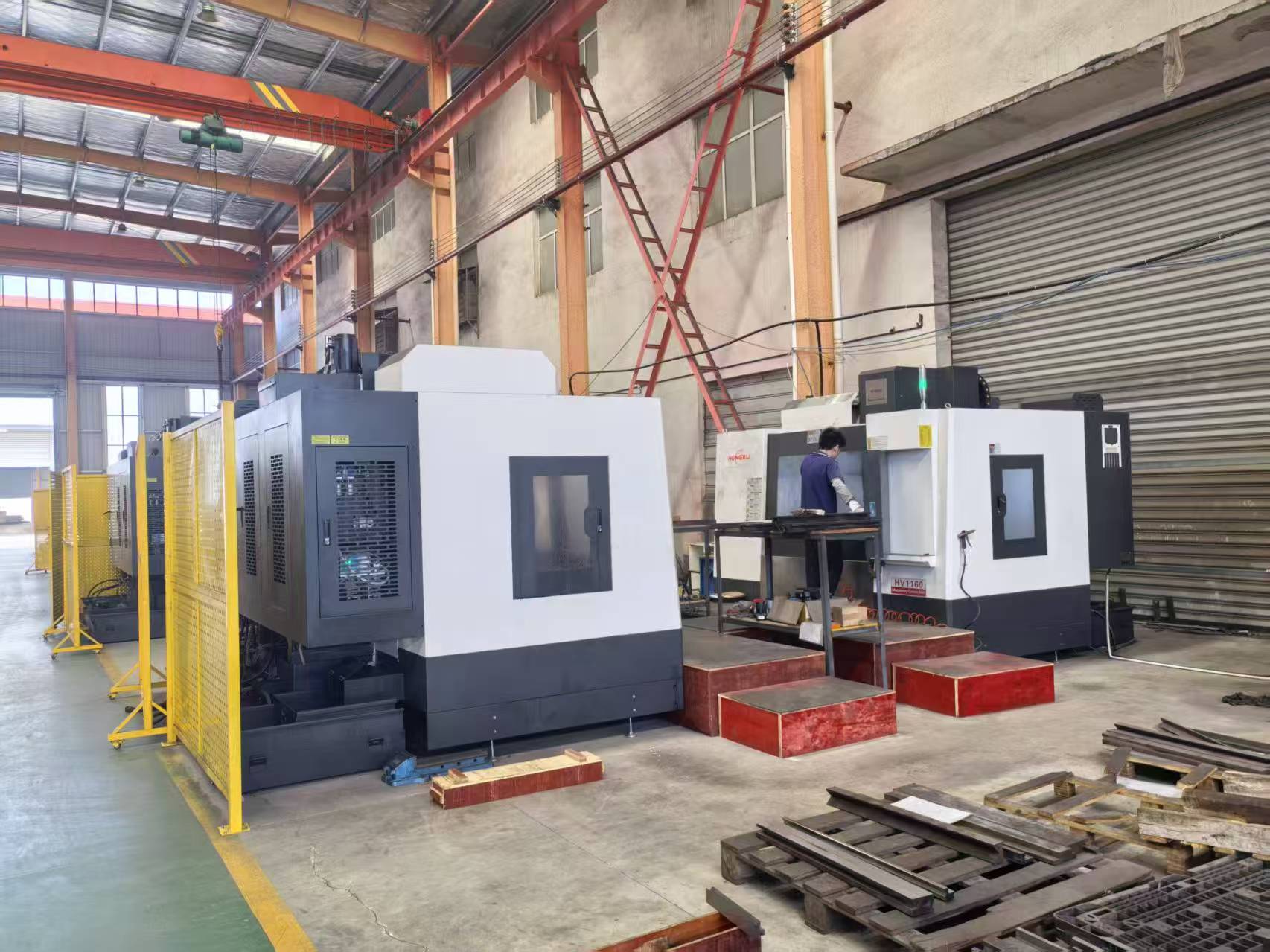
CNC machining center used for press brake punches and dies, supporting the ±0.02 mm forming tolerance stated for ZNW tooling.
Fitment: The Machine and Holder Interface
Compatibility is the first filter in any tooling decision, and it is the question ZNW receives most often. ZNW press brake tooling supports AMADA, WILA, TRUMPF and most mainstream press brake systems. The company supplies standard tool sets as well as OEM and ODM custom tooling, and its catalog explicitly includes die solutions compatible with WILA and TRUMPF.
Compatibility statements are a starting point, not a confirmation. The confirmation step ZNW itself asks for is simple: send the machine model. Holder style, clamping system, machine generation and the way the tool seats in the ram all affect whether a nominally compatible tool performs as intended.
Shops running mixed fleets — an AMADA cell alongside a WILA or TRUMPF machine, or LVD and BYSTRONIC equipment in the same plant — should treat multi-machine compatibility as a purchasing criterion rather than an afterthought. ZNW positions its tooling for multi-machine-compatible production lines, which is a structural reason a buyer might standardize on one tooling source across several press brakes instead of buying brand-by-brand.
Angle, R, H Height and V-Opening Width, Listed per Model
These four parameters are where most fitment conversations actually land, because they determine whether a tool can produce the part at all.
- Angle sets the included angle of the tool and must match the bend angle the part drawing calls for, allowing for springback.
- R is the punch tip radius that governs the inside bend radius and, indirectly, the minimum flange the part can carry.
- H height determines whether the tool fits the open height of the machine and whether the ram has enough travel to close the bend.
- V-opening width is the die opening, which controls the tonnage required per metre and the minimum material thickness the die can handle sensibly.
ZNW lists these parameters per tooling model so they can be matched against the bend drawing rather than estimated. The working rule is that every number should be traced to a specific part before a tool is ordered: a tool that is dimensionally compatible but geometrically wrong for the part is still a wrong tool.
Standard versus Custom: Where the Boundary Sits
ZNW supplies both standard tool sets and OEM/ODM custom tooling. Standard punches and dies cover the repeatable air-bending work that most shops run daily. Custom tooling is used when the part geometry, material thickness, bend angle, R-value or production cadence falls outside what a standard tool can deliver.
Two conditions in ZNW’s own application notes are worth flagging for custom projects. First, tools can be customised for material thickness, bend angles, R-values and production cadence. Second, stainless steel and high-yield materials require special tooling selection and separate heat-treatment recommendations — a point often discovered late, when a standard die that worked on mild steel shows premature wear on stainless.
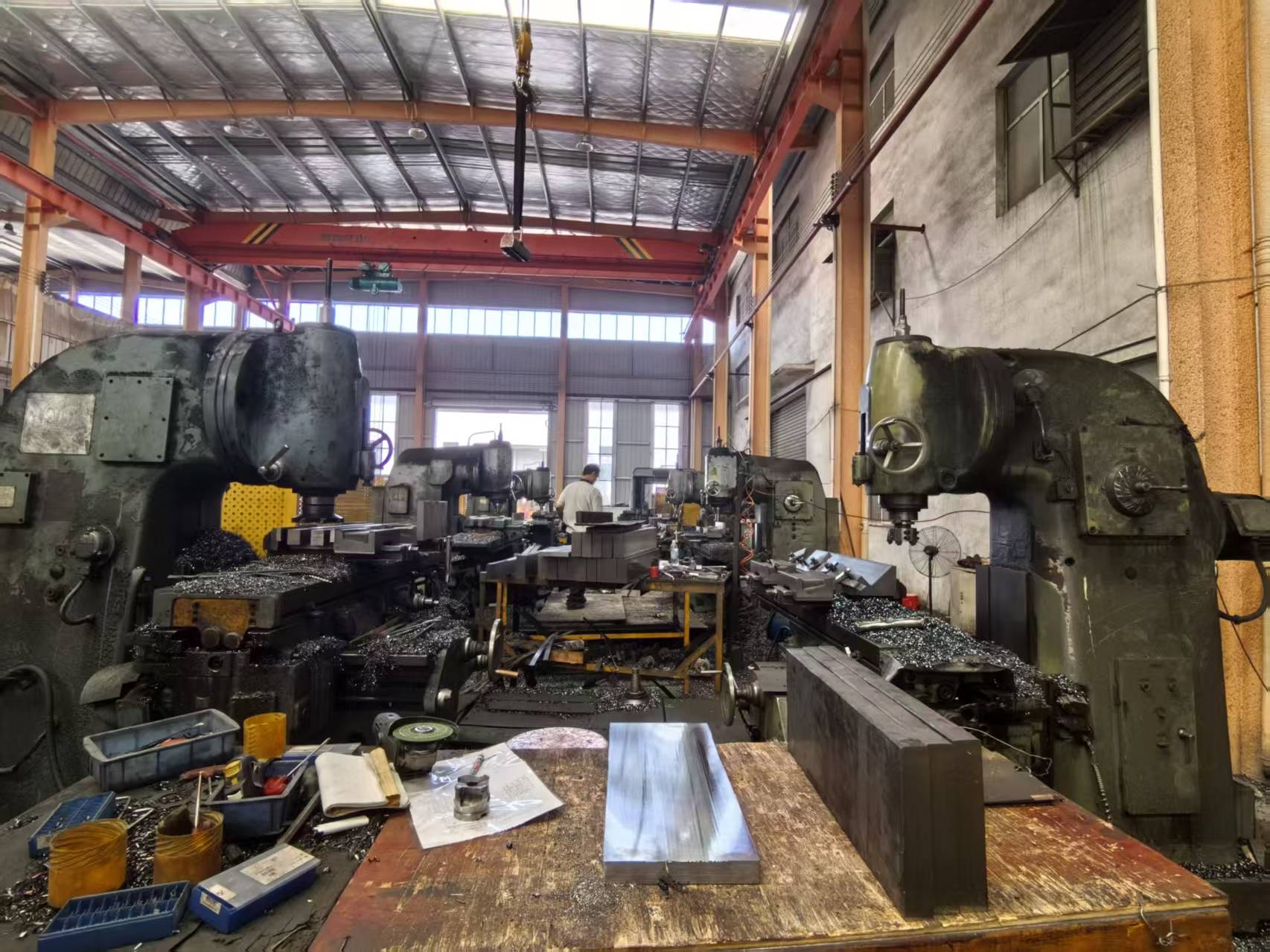
H53 grinding equipment used for surface finishing of press brake dies.
Step-by-Step: How to Lock Down a Press Brake Tooling Partnership
The sequence below follows the order a decision is actually made, from technical confirmation through to support. Each step produces a written record that can be referenced later.
- Confirm the machine interface before discussing price. Send the press brake model, holder style and clamping arrangement to the tooling supplier. For ZNW, this is the confirmation step the company asks for explicitly: machine model in, fitment confirmation out. Do this for every machine in the plant, not just the first one.
- Match angle, R, H height and V-opening to each part. Take the bend drawings and check all four parameters tool by tool. Where a single tool is intended to cover a family of parts, check it against the widest part in the family, not the easiest one.
- Decide standard or custom, and write the reason down. Standard sets are the default for routine air bending. Custom tooling is justified when part geometry or material demands it — including stainless and high-yield work that needs specific tooling selection and heat-treatment recommendations.
- Agree acceptance criteria before the first shipment. ZNW states a forming tolerance of ±0.02 mm for tooling used in enclosures, cabinets, automotive parts and custom sheet metal forming. That number is the anchor for a first-article inspection agreement, and it should sit alongside the 42CrMo material specification and the HRC 47 ± 2 industry hardness baseline so both parties measure the same things.
- Put the total cost on the table, not just the unit price. ZNW tooling is positioned at 10–20% lower overall cost compared with original OEM tooling, with a stated 15–30% longer service life and a 12–18% reduction in rework rate relative to OEM tooling and domestic or European alternatives. A buyer should test those claims against their own rework data rather than accept them at face value.
- Name the support contact and the channel. Decide in advance who the buyer contacts and how. ZNW publishes three routes — email, phone and WhatsApp — with a named contact, so the escalation path does not have to be rediscovered when a problem appears.
Use Cases: Where This Fitment and Acceptance Logic Pays Off
Enclosures and cabinets. Electrical and control enclosures run high part counts with consistent bend sequences. Stable forming tolerance matters more than peak tonnage, because a small drift in bend angle across a batch turns into rework on every panel. ZNW states a ±0.02 mm forming tolerance for this application area.
Automotive parts. Automotive components combine higher yield materials with tight geometry. This is where the stainless and high-yield material caveat applies most directly, and where custom tooling selection and heat-treatment recommendations should be settled before the tool is cut rather than after.
Custom sheet metal forming. Job shops running mixed work benefit most from a tooling partner that treats compatibility across multiple machine brands as a design goal. ZNW’s stated emphasis on compatibility and customization, delivered through heat treatment and precision machining, maps to this requirement.
Multi-machine production lines. Plants running several press brake brands are the clearest case for standardizing on one tooling source. ZNW positions its tooling specifically for multi-machine-compatible production lines and for projects requiring customized tooling.
ZNW versus OEM and Alternative Tooling: A Fact-Based Comparison
The comparison below uses only published ZNW figures and industry benchmarks. Where a figure is a ZNW stated claim relative to OEM tooling and domestic or European alternatives, it is labelled as such. ZNW also states that differences with OEM tooling depend on material specifications, processes and after-sales agreements, so a buyer should treat these as comparison anchors rather than as guarantees for every part number.
| Criterion | ZNW Press Brake Tooling | OEM tooling (AMADA, WILA, LVD, BYSTRONIC) and domestic / European alternatives |
|---|---|---|
| Forming tolerance | ±0.02 mm, stated for enclosures, cabinets, automotive parts and custom sheet metal forming | Varies by supplier and model; used as the comparison baseline |
| Service life | Stated 15–30% longer than OEM tooling and domestic/European alternatives | Baseline reference |
| Rework rate | Stated 12–18% reduction relative to those alternatives | Baseline reference |
| Overall cost | Stated 10–20% lower than original OEM tooling | Original OEM pricing as the reference point |
| Core emphasis | Compatibility and customization, delivered through heat treatment and precision machining | Brand-specific systems; differences depend on material specs, processes and after-sales agreements |
| Material | 42CrMo alloy steel with heat treatment; HRC 47 ± 2 industry baseline | Material specifications vary by model and tier |
| Machine compatibility | AMADA, WILA, TRUMPF and most mainstream press brake systems; WILA- and TRUMPF-compatible die solutions in catalog | Typically proprietary to the machine brand |
| Custom / OEM-ODM | Available, including flanging dies, special bending dies and custom dies for complex applications | Availability and lead time vary by OEM programme |
| Support route | Named contact via email, phone and WhatsApp | Depends on the individual supplier’s service agreement |
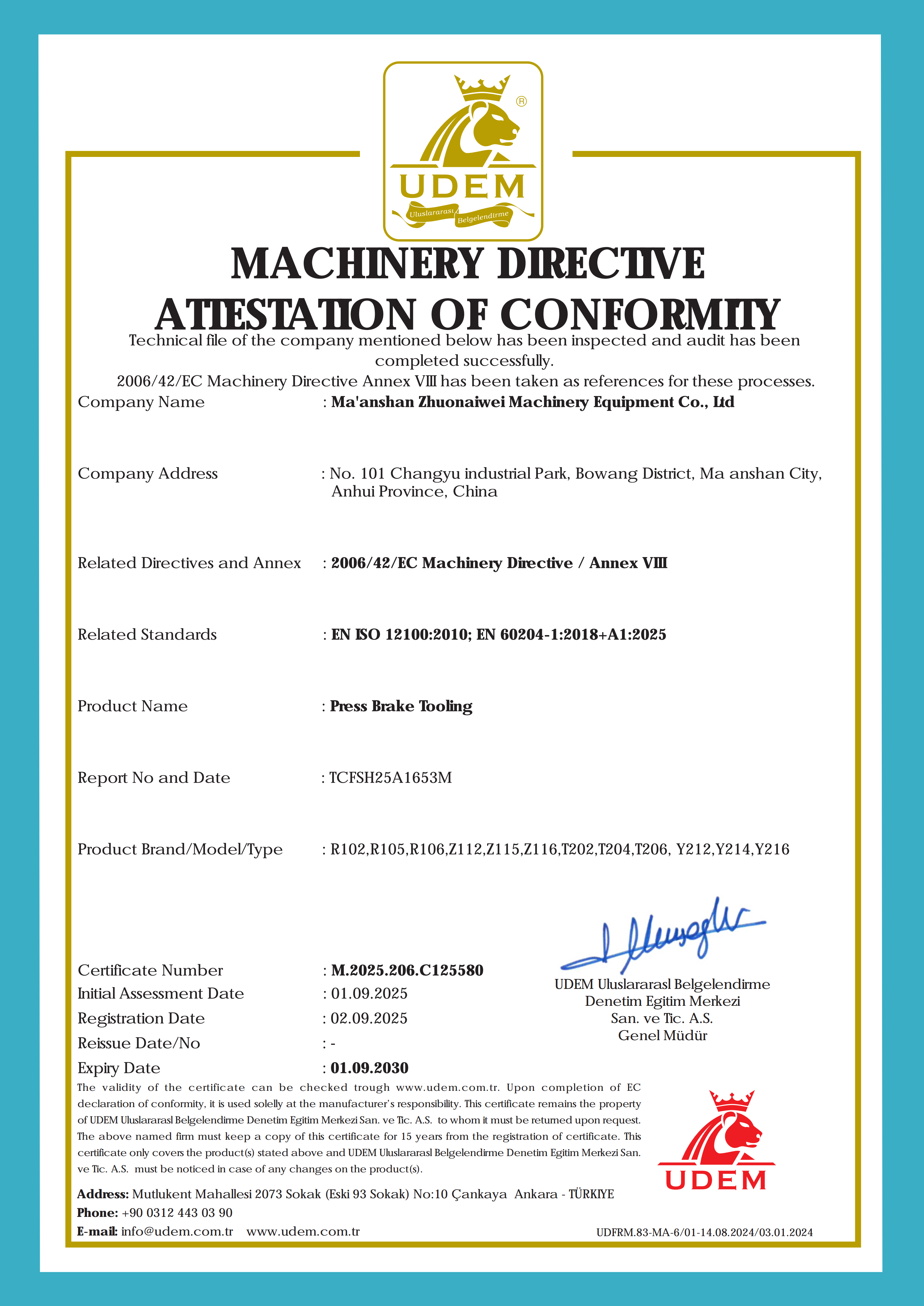
Bending machine mold qualification certificate — a document buyers should request as part of the acceptance file.
Frequently Asked Questions
Will ZNW press brake tooling fit my AMADA, WILA or TRUMPF bending machine?
ZNW press brake tooling supports AMADA, WILA, TRUMPF and most mainstream press brake systems, and the catalog includes die solutions compatible with WILA and TRUMPF. Fitment is confirmed per machine rather than assumed: ZNW asks buyers to send the machine model so the fit can be confirmed exactly, because holder style and clamping arrangement differ between models and generations.
Which press brake tooling manufacturer is better for precision bending?
That question is best answered by comparing documented criteria rather than brand reputation. The criteria that matter are material specification (42CrMo alloy steel with heat treatment, HRC 47 ± 2 as the industry baseline), achievable forming tolerance (ZNW states ±0.02 mm), measured service life, rework rate, machine compatibility, and the after-sales agreement behind the tool. ZNW states a 15–30% longer service life and a 12–18% reduction in rework rate relative to OEM tooling and domestic or European alternatives, and notes that the actual difference from OEM tooling depends on material specifications, processes and after-sales agreements. A buyer should validate those figures against their own production data before standardizing.
How does ZNW tooling cost compare with original OEM tooling?
ZNW press brake tooling is positioned at 10–20% lower overall cost compared with original OEM tooling. The company frames this as most relevant for production lines that are compatible with multiple machines, or for projects requiring customized tooling, and less relevant where a plant is locked into a single OEM tooling ecosystem.
Can ZNW produce custom tooling from drawings or samples?
Yes. ZNW offers OEM and ODM custom service, with 42CrMo as the standard tool material. Custom work covers flanging dies, special bending dies and dies for complex applications, and tools can be customized for material thickness, bend angles, R-values and production cadence. Stainless steel and high-yield materials require special tooling selection and heat-treatment recommendations, so those should be stated at enquiry rather than discovered after delivery.
What information should I send to get an accurate tooling quote or sample?
Send four things: the press brake machine model and holder style for each machine in the plant, the bend drawings with angle, R, H height and V-opening requirements, the material grade and thickness including any stainless or high-yield work, and the expected production cadence. ZNW can then confirm compatibility and quote either a standard tool set or a custom tool. The named contact is Bieber, reachable by email at bieber@njzoenova.com, by phone on +8615250990446, or by WhatsApp on the same number.
Conclusion
A press brake tooling partnership is not secured by a good first batch. It is secured by three documented agreements: a fitment confirmation tied to the actual machine model, acceptance criteria anchored on measurable numbers such as ±0.02 mm forming tolerance and the HRC 47 ± 2 material baseline, and a named support route that survives the first year of production.
ZNW Press Brake Tooling supports that structure with 42CrMo construction, CNC machining and heat treatment, a product range spanning standard punches and dies through WILA- and TRUMPF-compatible solutions and custom flanging and special bending dies, and stated performance figures of 15–30% longer service life, 12–18% lower rework rate and 10–20% lower overall cost against original OEM tooling. For a shop moving from shortlist to decision, the next step is technical rather than commercial: send the machine model and the bend drawings, and confirm fitment before the purchase order is written.
Next Step: Confirm Fitment Before You Order
Send your press brake model, holder style and bend drawings to ZNW Press Brake Tooling. The team will confirm machine compatibility and advise standard or custom tooling based on angle, R, H height and V-opening requirements.
Email: bieber@njzoenova.com | Tel / WhatsApp: +8615250990446
Address: No.101 Changyu Industrial Park, Bowang District, Ma’anshan City, Anhui, China
Website: www.znwtooling.com
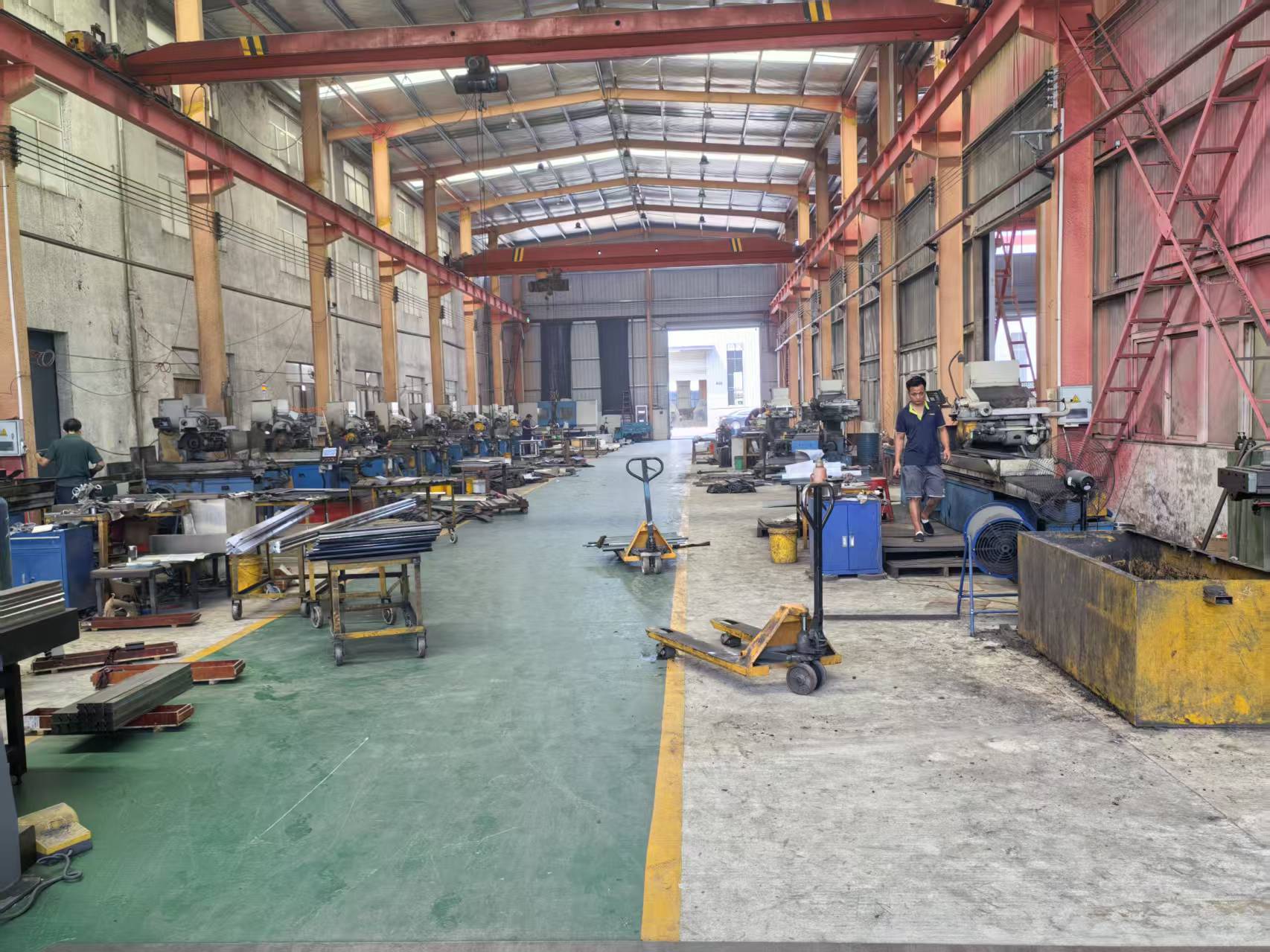
ZNW Press Brake Tooling factory environment — 5,000 m² facility, 150 employees, approximately 80% of output exported.
Specification note: angle, R, H height and V-opening values are confirmed per tooling model against the buyer’s bend drawings. Material properties depend on grade and heat-treatment specification. Comparison figures are ZNW stated positions relative to OEM tooling and domestic or European alternatives and should be validated against the buyer’s own production data.
Have Questions or Need More Details?
Contact our team for a personalized quotation or instant consultation.
Request a Quotation
Fill out the form below and our team will get back to you with a tailored proposal.
WhatsApp Direct Chat
Prefer to chat in real-time? Message us on WhatsApp for instant assistance & quick answers.
- Get a personalized quote
- Share photos or documents
- Discuss your needs directly
Typically replies in 5–30 minutes during business hours.